

Table of Contents
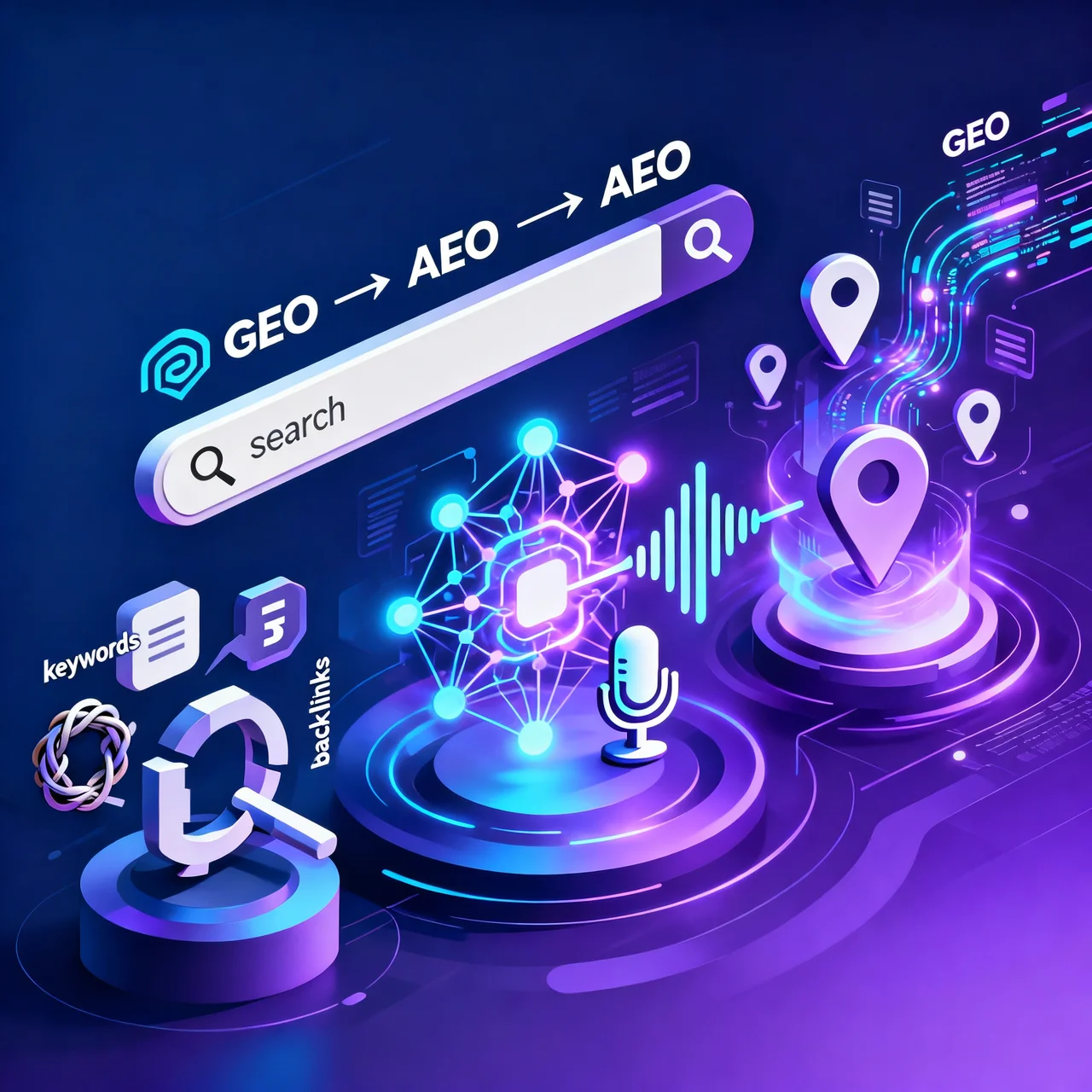
ToggleThe search evolution from SEO to GEO and AEO is not a story about one discipline replacing another. It is a story about how people find answers. Ten blue links once defined discovery. Today, searchers also meet AI-generated summaries, cited chatbot answers, and conversational follow-up questions.
This guide explains traditional SEO, answer engine optimisation (AEO), and generative engine optimisation (GEO). It shows how they overlap, what has changed in 2026, and what you can do about it. Throughout, claims are labelled as verified (from official documentation or published research), analysis (reasoned interpretation), or prediction (plausible, not certain).
One rule applies to everything below: nobody can guarantee rankings, AI citations, or traffic. You can only improve the quality, clarity, and accessibility of your pages.
Table of Contents
- How Traditional SEO Worked
- Why Traditional Search Is Evolving
- What Is Answer Engine Optimisation (AEO)?
- What Is Generative Engine Optimisation (GEO)?
- SEO vs AEO vs GEO: Key Differences
- The Role of AI Search in 2026
- How Search Intent and Content Quality Have Evolved
- Technical SEO Foundations for AI Search
- 12 Practical Strategies for SEO, AEO, and GEO
- How to Measure SEO, AEO, and GEO Performance
- Common SEO, AEO, and GEO Mistakes
- A Practical 30-Day SEO-to-GEO and AEO Action Plan
- The Future of Search: What Marketers Should Prepare For
- Conclusion: Building a Search Strategy Beyond Traditional SEO
- Frequently Asked Questions
1. How Traditional SEO Worked
Traditional SEO grew around a simple loop. A crawler finds pages, an index stores them, and ranking systems order them for each query. Google’s explanation of how Search works describes these stages, and its SEO Starter Guide covers the basics of helping search engines crawl, index, and understand a site.
Crawling, indexing, and ranking
A page that is never crawled or indexed cannot appear in results, however good it is. Early SEO work therefore focused on access: clean URLs, working links, XML sitemaps, and sensible robots.txt rules. Ranking came next, and it depended on hundreds of signals that Google does not publish in full.
Keywords and search intent
Keywords told search engines what a page covered. Over time, search intent became just as important. Imagine an online shop selling running shoes. “How to choose running shoes” is informational, while “best trail running shoes” is commercial. Each needs a different page, not the same page with swapped keywords.
Backlinks and authority
Links from other sites acted as references. Relevant links from trusted sources helped pages get discovered and gain credibility. This also created a market for manipulative link buying, which Google’s spam policies address.
On-page and technical SEO
On-page SEO covered titles, headings, copy, images, and internal links. Technical SEO covered speed, mobile usability, canonical URLs, redirects, and HTTPS. Both remain relevant, as later sections show.
Search engine results pages, organic traffic, and click-through rates
The search engine results page (SERP) was a list of links, sometimes with ads, maps, or snippets. Success meant a high position and a good click-through rate (CTR). Organic traffic was the main prize, and rank tracking was the main scoreboard.
Helpful content
Google increasingly stressed helpful, reliable, people-first content. That guidance matters even more now, because AI features build on the same index and quality systems.
2. Why Traditional Search Is Evolving
The search evolution from SEO to GEO and AEO did not happen overnight. Several changes built up gradually, and not all of them are about AI.
- Conversational queries. People type or speak full questions instead of two-word keywords.
- Mobile and voice search. Small screens and spoken queries favour short, direct answers.
- Semantic search. Search systems increasingly interpret meaning and intent, not only exact words.
- Featured snippets and direct answers. Google’s featured snippets already pulled answers onto the results page.
- Zero-click searches. When the answer appears on the results page, some users never visit a website.
- AI-powered search experiences. Summaries, cited chat answers, and multi-step research modes now sit beside or replace link lists.
- Faster expectations. Many searchers now expect a synthesised answer, then a way to dig deeper.
Fact versus analysis: The existence of AI answer features is verified. How much they reduce clicks varies by query type, industry, and measurement method. Treat any single “traffic loss” percentage with caution unless the methodology is clear.
3. What Is Answer Engine Optimisation (AEO)?
Answer engine optimisation (AEO) means making your content easy to understand and extract as a direct answer to a specific question. The target might be a featured snippet, a voice assistant response, or an AI-generated answer.
How answer engines present answers
Answer engines identify a question, find pages that address it, and show a concise response. Google has said that featured snippets are generated automatically from page content, so you cannot simply mark a page up to win one. Your job is to write clearly and structure pages sensibly.
Practical AEO habits
- Answer the question directly near the top of the relevant section.
- Use question-based headings when they match real queries.
- Give a short definition, then add detail.
- Use lists and tables where the answer is a set of steps or comparisons.
- Keep one main topic per section.
Three before-and-after examples
Example 1: definition.
Before: “Canonical URLs have been a talking point in technical SEO for many years, and many professionals have strong views on them.”
After: “A canonical URL is the preferred version of a page when several URLs show similar content. It tells search engines which version to treat as the main one.”
Example 2: how-to.
Before: “There are many ways to speed up a website, depending on the setup, hosting, and plugins.”
After: “To speed up a WordPress site, compress images, remove unused plugins, enable caching, and test key pages in PageSpeed Insights. Start with the largest images, because they often cause the biggest delays.”
Example 3: comparison.
Before: “Choosing between guest posting and digital PR is something many marketers think about.”
After: “Guest posting means writing content for another site, while digital PR means earning coverage through newsworthy resources or expert commentary. Guest posting offers more control. Digital PR usually depends on the publisher’s own editorial decision.”
FAQ content and structured data: the limits
FAQ sections help readers when the questions are real. FAQ markup, however, is subject to Google’s current eligibility rules, and rich results are never guaranteed. Structured data helps machines interpret a page, but it does not guarantee a featured snippet or an AI citation. Google’s structured data introduction explains what markup can and cannot do.
4. What Is Generative Engine Optimisation (GEO)?
Generative engine optimisation (GEO) is the practice of improving how your content is retrieved, understood, and cited in AI-generated answers. The term was formalised in a research paper, “GEO: Generative Engine Optimization”, by Aggarwal and colleagues, accepted at KDD 2024. The authors reported that some content changes raised visibility by up to 40% in their test setup.
Important caution: that result comes from a specific benchmark and experimental design. Live products change constantly, so the figure should not be treated as a promise for your website.
How generative answers are built
Google’s guidance on optimizing for generative AI features describes two techniques. Retrieval-augmented generation retrieves relevant pages from the search index and uses them to ground an answer. Query fan-out runs several related searches to cover subtopics of the original question.
For example, a question about fixing a weedy lawn may trigger related searches on herbicides, chemical-free removal, and prevention. Your page can be retrieved for a related sub-question even if it never used the searcher’s exact words.
What GEO focuses on
- Clear, factual, well-supported content that a system can retrieve and summarise accurately.
- Entity recognition and context. Systems need to understand who you are and what you cover.
- Reputation and brand mentions. Genuine mentions in articles, reviews, and discussions may help systems understand your brand. Manufactured mentions are another matter, as Google’s guidance notes.
- Original research and unique insight that cannot be copied from other pages.
- Freshness and accuracy for topics that change.
- Accessibility to crawlers so that retrieval systems can fetch the page at all.
GEO is emerging, not settled
GEO is an emerging discipline. No universally accepted formula guarantees inclusion in generative answers, and different platforms retrieve and cite sources differently. From Google Search’s perspective, according to its own documentation, work on AEO and GEO is still SEO. Evaluate third-party GEO advice against official guidance such as Google’s guidance on third-party SEO advice.
Understanding the search evolution from SEO to GEO and AEO helps you ignore hype and focus on durable work.
5. SEO vs AEO vs GEO: Key Differences in the Search Evolution from SEO to GEO and AEO
| Factor | Traditional SEO | AEO | GEO |
|---|---|---|---|
| Main objective | Earn visibility and clicks in organic results | Be the clear, extractable answer to a specific question | Be retrieved and cited in generated answers |
| Typical search experience | Ranked list of links | Snippets, direct answers, voice replies | AI summaries, chat answers, multi-step research |
| Content format | Pages targeting topics and keywords | Concise definitions, steps, tables, question headings | Well-sourced, original, entity-rich pages |
| User behaviour | Scan results and click | Read the answer, sometimes without clicking | Ask follow-ups, review cited sources |
| Visibility signals | Relevance, quality, links, page experience | Clarity, relevance, page quality | Retrievability, trust, uniqueness, reputation (platform-dependent) |
| Measurement | Clicks, impressions, positions, conversions | Snippet presence, impressions, brand queries | Citations, AI impressions, referrals, brand mentions |
| Technical considerations | Crawlability, indexing, speed, mobile | Clean structure, relevant markup | Same foundations; platform crawler access |
| Limitations | Fewer clicks when answers appear on the SERP | No guaranteed snippet; answers may satisfy users without a visit | Opaque systems, no formula, limited reporting |
These approaches overlap heavily. A clear, accurate page that is crawlable and trustworthy serves all three. The difference is where the reader meets your content: in a list of links, in a snippet, or inside a generated answer.
6. The Role of AI Search in 2026
Within the search evolution from SEO to GEO and AEO, AI search is not one product. Each platform works differently, so avoid assuming one set of ranking signals.
Google AI Overviews and AI Mode
Verified: Google’s AI features documentation describes AI Overviews and AI Mode. Both may use query fan-out, and they may use different models and techniques, so their responses and links can differ. To be shown as a supporting link, a page must be indexed and eligible to appear in Search with a snippet. AI Overviews began as the Search Generative Experience and were renamed in 2024. AI Mode was tested from March 2025.
ChatGPT search
Verified: OpenAI introduced ChatGPT search in October 2024. Its help documentation says responses may include inline citations and a Sources panel, and that search may use third-party providers. OpenAI also notes that ChatGPT can produce inaccurate or misattributed citations, so verification matters.
Microsoft Copilot and Bing
Verified: Microsoft added an AI Performance report to Bing Webmaster Tools in 2026 (see the Bing announcement). It reports citations across Microsoft Copilot, AI summaries in Bing, and select partner experiences.
Perplexity
Verified: Perplexity describes its product as a search tool that searches the web in real time and returns summaries with numbered citations (see its explanation of how it works).
What this may change
Analysis: These products differ in citation style, source selection, and traffic potential. A citation can build awareness without producing a visit. Some queries, especially complex research questions, may send more users into AI modes, while simple navigational queries may stay in traditional results. Test your own queries rather than relying on generalisations.
7. How Search Intent and Content Quality Have Evolved
Throughout the search evolution from SEO to GEO and AEO, search intent still decides whether a page deserves to appear. The four familiar types continue to apply:
- Informational: “what is query fan-out”
- Commercial: “best SEO tools for small businesses”
- Transactional: “buy keyword research tool subscription”
- Navigational: “Google Search Console login”
What has changed is the standard for satisfying that intent. Repeating a keyword does not help when AI systems can understand meaning and synonyms. Google’s AI optimisation guidance advises against writing content only for AI systems and recommends non-commodity content: pages that offer a unique viewpoint, first-hand experience, or in-depth knowledge rather than a rewrite of common advice.
Practically, that means showing your work. Add screenshots from your own tests, explain how you reached a conclusion, name the author, and link to primary sources. These signals help readers trust the page, and they fit with the idea of E-E-A-T (experience, expertise, authoritativeness, and trust) as a way to think about quality, not as a checklist or a direct ranking factor.
8. Technical SEO Foundations for AI Search
Even after the search evolution from SEO to GEO and AEO, technical SEO still determines whether your content can be found and used.
Confirmed by official documentation (Google)
- A page must be indexed and eligible to appear in Search with a snippet to be shown in generative features.
- Content should be crawlable. Blocked or hidden content cannot be used.
- No special AI schema is needed, and creating llms.txt files or similar is not required for Google Search.
- You do not need to chunk content artificially or rewrite it only for AI systems.
- Following JavaScript SEO best practices matters if your site relies on scripts.
Good practice that supports usability
- Accessible HTML: put important text in the page, not only inside images or scripts.
- Internal linking: link related pages with descriptive anchor text.
- Canonical URLs and XML sitemaps: reduce duplicates and list preferred URLs.
- Mobile usability and page performance: test key pages with PageSpeed Insights.
- Clear page hierarchy: one H1, logical H2 and H3 headings.
- Structured data where relevant: use Article, Organization, or BreadcrumbList markup if it matches visible content.
Other platforms may use their own crawlers and controls, so check their documentation instead of assuming Google’s rules apply everywhere.
9. 12 Practical Strategies to Optimise Content for SEO, AEO, and GEO
These strategies serve the search evolution from SEO to GEO and AEO without chasing platform-specific tricks. Each one explains what to do, why it matters, and gives an example.
1. Answer the main question early
What to do: State the core answer in the first lines of the page or section.
Why it matters: Readers, snippets, and retrieval systems can find the answer quickly.
Example: Under “What is a canonical URL?”, start with one sentence defining it, then explain how to implement it.
2. Use descriptive headings
What to do: Write headings that describe the section’s content, and use question headings where real users ask those questions.
Why it matters: Clear headings help people and systems navigate topics.
Example: Replace “Overview” with “How Query Fan-Out Works in AI Search”.
3. Give a concise definition, then deeper explanation
What to do: Pair a short definition with context, an example, and limitations.
Why it matters: Short answers are easy to extract, while the deeper material earns trust.
Example: Define AEO in two sentences, then explain how it differs from featured snippet optimisation.
4. Add original examples and expert commentary
What to do: Include your own tests, client-safe lessons, screenshots, or opinions labelled as opinions.
Why it matters: Google’s guidance favours content with a unique viewpoint over recycled summaries.
Example: Instead of “7 SEO tips”, write “What changed after I rewrote 10 old posts to answer questions earlier”.
5. Support factual claims with reliable references
What to do: Link to primary sources, such as official documentation or published research, near the claim.
Why it matters: References help readers verify your work and reduce the risk of repeating errors.
Example: Link to Google’s AI features documentation when you describe AI Overviews eligibility.
6. Build topical depth across related articles
What to do: Cover a subject through connected articles, from beginner definitions to advanced guides. For example, you could explore more SEO and digital marketing guides on a site that covers each stage.
Why it matters: Topical authority comes from consistent, useful coverage, not one isolated page.
Example: Pair this overview with separate posts on featured snippets, structured data, and Search Console reporting.
7. Strengthen internal links
What to do: Link related pages with descriptive anchor text, and fix orphan pages.
Why it matters: Internal links help crawlers and readers discover related content.
Example: From an AEO article, link to your guide on writing meta descriptions using the anchor “meta description best practices”.
8. Maintain consistent brand and entity information
What to do: Use the same business name, author names, descriptions, and profile links across your site and public profiles.
Why it matters: Consistency helps search systems connect your content with the right entity.
Example: Keep your About page, author bios, and social profiles aligned on the same name and focus areas.
9. Use appropriate structured data
What to do: Add Article and BreadcrumbList markup if they match the page, and validate with Google’s Rich Results Test.
Why it matters: Markup can support rich result eligibility and help machines read page details, though it does not guarantee citations.
Example: Do not add Review markup to a page that contains no real reviews.
10. Improve accessibility and technical health
What to do: Fix crawl errors, broken links, slow pages, missing alt text, and poor mobile layouts.
Why it matters: Accessible, fast pages work better for users, screen readers, crawlers, and AI browsing agents.
Example: Compress oversized hero images and set image dimensions to reduce layout shifts.
11. Update genuinely outdated information
What to do: Review pages on a schedule and change statements that are no longer true.
Why it matters: Outdated advice misleads readers and weakens trust.
Example: Revise a post that still treats FAQ rich results as widely available. Do not change dates artificially.
12. Create original research or useful resources
What to do: Publish surveys, benchmarks, templates, calculators, or case studies from your own work, with a clear method.
Why it matters: Original material gives others a reason to cite you and adds something AI summaries cannot invent.
Example: A downloadable AI-search audit checklist with clear instructions for each step.
10. How to Measure SEO, AEO, and GEO Performance
Measurement is the weakest part of the search evolution from SEO to GEO and AEO. Traditional metrics are mature. AI visibility reporting is partial and platform-specific.
Traditional metrics still matter
- Organic clicks, impressions, CTR, and average position: available in Google Search Console.
- Conversions and leads: track in your analytics tool, such as form submissions or purchases.
- Assisted conversions: check whether organic or AI referrals appear earlier in the customer journey.
Emerging AI visibility measurements
- Google: Google’s guidance points to the Generative AI performance report in Search Console for AI Overviews and AI Mode visibility. Industry coverage at launch reported that it focuses on impressions rather than clicks, so check the current documentation for what it includes.
- Bing and Copilot: Bing Webmaster Tools’ AI Performance report shows citation data for supported Microsoft surfaces.
- Referral traffic: check analytics for visits from AI platforms. Some visits may be hard to attribute.
- Brand mentions and linked sources: review manually by asking relevant questions on each platform and recording whether your pages appear. Treat results as samples, because answers can change.
Limits of third-party AI visibility tools
Google states that no third-party tool has access to its internal ranking or AI systems. Such tools can help with sampling and monitoring, but they cannot show complete or official data. Do not rely on one visibility score. Combine Search Console, analytics, platform reports, and manual checks.
11. Common SEO, AEO, and GEO Mistakes
| Mistake | Why it hurts | How to correct it |
|---|---|---|
| Abandoning traditional SEO | AI features rely on the same index and quality systems | Keep crawlability, content quality, and links as the base |
| Writing only for AI systems | Readers lose; Google advises against it | Write for the audience first |
| Keyword stuffing | Reduces readability and trust | Use natural language and relevant terms |
| Mass-producing generic AI content | Adds no value and may violate scaled content policies | Add original insight and human review |
| Inventing facts or statistics | Damages credibility | Cite verifiable sources or omit the claim |
| Adding irrelevant structured data | May be ignored or violate guidelines | Mark up only visible, accurate content |
| Buying manipulative backlinks | Breaches spam policies | Earn links through useful resources |
| Assuming an AI mention brings traffic | A citation may not produce clicks | Track referrals and conversions separately |
| Treating all AI platforms alike | Each uses different retrieval and citation methods | Read each platform’s documentation |
| Chasing vanity metrics | Impressions alone do not show business impact | Tie reporting to leads, sales, or engagement |
12. A Practical 30-Day SEO-to-GEO and AEO Action Plan
This schedule supports the search evolution from SEO to GEO and AEO in a realistic, repeatable way. It does not promise ranking or citation improvements within 30 days, because results depend on competition, indexing, content quality, and many other factors.
| Week | Objectives | Tasks | Expected deliverables |
|---|---|---|---|
| Week 1 | Audit technical SEO, content, and intent | Verify Search Console and Bing Webmaster Tools; review indexing; list top pages; label each page’s search intent; find outdated content | Audit spreadsheet with priorities |
| Week 2 | Improve important pages and answer sections | Rewrite introductions to answer questions early; improve headings; add concise definitions; fix technical issues on key pages | 5-10 improved pages, updated structured data where relevant |
| Week 3 | Strengthen topical authority, internal links, and original content | Map related articles; add descriptive internal links; draft one original resource, such as a checklist or mini-study | Topic cluster map, new internal links, one original asset |
| Week 4 | Establish tracking and review early findings | Set up dashboards; record baseline clicks and impressions; test target questions on AI platforms; document observations | Monthly report and next-quarter priorities |
13. The Future of Search: What Marketers Should Prepare For
The search evolution from SEO to GEO and AEO is still unfolding, so it helps to separate what is established from what is only predicted.
Established trends
- AI-generated answers and conversational search are now part of mainstream search products.
- Platforms are adding reporting for AI visibility, though coverage is uneven.
- Google’s official guidance still ties AI features to core Search quality systems.
Predictions (not certainties)
- Search may become more task-oriented, with AI agents comparing products or booking services. Google’s guidance already mentions agentic experiences as something to explore if relevant.
- Brand reputation and original data may matter more as generic content becomes easy to produce.
- Measurement may improve, but platform differences will probably remain.
Fundamentals likely to stay valuable
Useful content, technical accessibility, trust, relevance, and a deep understanding of your audience have outlasted every previous change in search. They are the best preparation for whatever comes next.
Conclusion: Building a Search Strategy Beyond Traditional SEO
The search evolution from SEO to GEO and AEO adds new places where your content can appear, but it does not remove the need for strong SEO. Traditional SEO makes pages findable. AEO makes answers clear. GEO focuses on being retrieved, understood, and cited in generated responses.
The three approaches complement one another. Start with crawlable, helpful, original pages, then refine structure, measure what you can, and stay sceptical of guarantees. Treat the search evolution from SEO to GEO and AEO as a reason to strengthen your foundations, not to abandon them.
For more practical walkthroughs, explore the practical digital marketing resources at Ansif Marketer.
Frequently Asked Questions
What is the difference between SEO, AEO, and GEO?
In the search evolution from SEO to GEO and AEO, SEO improves visibility in search results. AEO focuses on clear answers to specific questions. GEO focuses on being retrieved and cited in AI-generated responses. They overlap, and all depend on quality, accessible content.
Is traditional SEO still important in 2026?
Yes. Google’s guidance says SEO best practices remain relevant because its generative AI features are rooted in core Search ranking and quality systems.
How can a website improve its chances of appearing in AI-generated answers?
Make sure pages are crawlable, indexed, and eligible to show snippets. Publish original, accurate, well-structured content, and keep it updated. No method guarantees inclusion.
Does GEO replace SEO?
No. GEO builds on SEO foundations. Google describes work on AI search as still SEO from its perspective, and other platforms also need accessible, trustworthy sources.
Can structured data guarantee AI citations?
No. Google states that structured data is not required for generative AI search and no special schema is needed. Structured data can still help with eligibility for rich results and machine understanding.
How can marketers measure AI search visibility?
Use Google Search Console, including its generative AI reporting where available, plus Bing Webmaster Tools’ AI Performance report, analytics referrals, and manual checks. No platform provides complete visibility, and third-party tools are estimates.
Auther :ansif muhammed




[…] Generative Engine Optimization (GEO) takes this concept further by focusing on how brands and their content appear within AI-generated responses. Platforms such as ChatGPT, Google Gemini, Perplexity, and other AI systems can summarize information from multiple sources when responding to complex questions. […]